

Why Patients Rock Before Standing
Understanding the Movement Breakdown Behind Sit-to-Stand
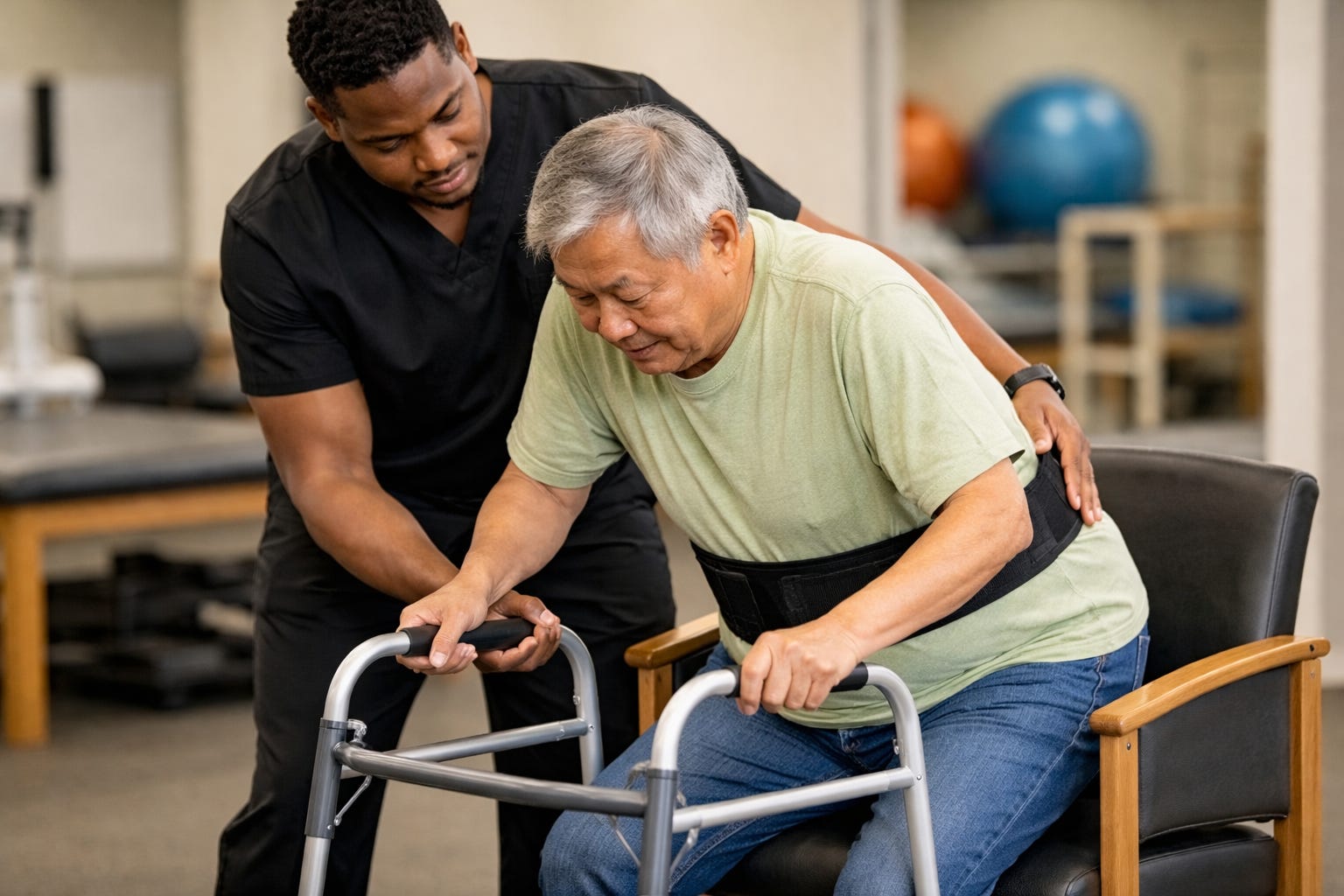
Sit-to-stand is one of those movements that looks simple until you really pay attention to it. Most of us don’t think about how we stand up from a chair. It happens as one continuous sequence. The body leans forward, weight shifts, the legs activate, and the movement carries through into standing without pause or reset. But in practice, we may see something different. A patient leans forward, then comes back, then tries again with a little more effort. Each attempt may go slightly further, with more pressure through the armrests, until after several tries they are finally able to stand.
That repeated rocking pattern shows up all the time, and it usually tells you more than it seems at first. What you’re seeing is a breakdown in how the body is coordinating the transition from sitting to standing. Instead of one smooth movement, it turns into a series of attempts, with the patient trying to build enough momentum to get up. When you start to look at it this way, the movement itself starts to show you where things are breaking down and why standing isn’t happening smoothly.
What Rocking Before Standing Represents
When a patient rocks before standing, the body is trying to generate enough forward momentum to initiate the movement.
At a basic level, sit-to-stand requires the body to do three things in sequence:
Shift the center of mass forward over the base of support
The movement starts with a forward lean. The trunk has to move far enough forward so the body’s weight comes over the feet. Without this shift, the hips stay loaded on the chair and the movement can’t progress. This is often where you’ll see hesitation or repeated attempts, especially if the patient doesn’t move forward far enough or has difficulty controlling that motion.Transition from a stable sitting position into a moment of controlled instability
Sitting is a stable position. Standing is also relatively stable once achieved. The challenge is the transition between the two. As the body moves forward and begins to lift, there is a brief moment where balance becomes less predictable. The body has to manage that shift without immediately falling back into the chair or overcorrecting. This is where you may see pauses, loss of alignment, or a quick return to sitting.Activate the lower extremities to extend into standing
Once the body is positioned forward, the legs need to generate enough force to bring the body upright. This isn’t just about strength. It’s also about timing. The legs have to activate at the right moment, in coordination with the forward shift. When that timing is off, the patient may reach the right position but still be unable to stand, often relying more heavily on the arms or trying again with increased effort.
This first step is where things often start to break down. The body has to move forward far enough to allow the hips to lift. When that forward shift is too small, poorly timed, or not well controlled, the movement stalls and the patient returns to sitting to try again. Over time, that’s when rocking shows up. Each forward lean becomes an attempt to build enough momentum to stand, turning what should be one smooth transition into a series of repeated efforts.
What You Might Notice Clinically
The pattern can look a little different depending on the patient, but there are some consistent features that tend to show up across settings. Once you start paying attention to the lead-in to standing, these details become much easier to pick up.
You might see:
Repeated forward and backward trunk movement before lift-off
The patient leans forward, comes back, and then tries again. Sometimes this happens a few times before anything else changes. It usually means they’re having trouble getting far enough forward, or staying there long enough, to actually start the movement.Increasing amplitude of each attempt as the patient “builds momentum”
Each attempt looks a little bigger than the last. They lean further forward or move with a bit more force each time. It’s the body trying to build enough momentum to get up when the movement isn’t coming together smoothly.A pause at the end of forward lean without successful initiation
They get into a position that looks like they should stand, but then nothing happens. There’s a brief pause, and then they sit back. That pause often tells you the positioning is there, but the next step isn’t connecting.Heavy reliance on upper extremities to push into standing
You’ll see more pressure through the hands, whether that’s on the armrests, their thighs, or the walker. Sometimes it’s subtle, sometimes it’s obvious. It can reflect reduced leg contribution, but it can also be a way to compensate when the timing of the movement feels off.Hesitation or visible effort just before the movement begins
There’s often a moment right before they move where you can see them thinking about it or preparing for it. It might look like a pause, a shift in posture, or increased effort. It usually reflects how much work it takes to organize the movement.Loss of alignment during attempts, including posterior lean when returning to sitting
As they try to stand or sit back down, you might see them lose midline, shift off to one side, or drop back into the chair with less control. This often shows up when the forward shift isn’t quite right or when balance is harder to manage during the transition.
Some patients will eventually stand after a few attempts. Others will still require assistance even after repeated rocking. The number of attempts matters less than what those attempts look like. The key is that the rocking itself is not random. It reflects how the body is trying, and often struggling, to organize the movement. When you start to look at it this way, each attempt gives you more information about where the breakdown is happening and what the patient needs to move more efficiently.
Breaking Down the Movement Sequence
If you slow the movement down and watch it step by step, the breakdown becomes much easier to see. Instead of focusing on whether the patient stands, your attention shifts to how the movement unfolds leading up to that moment. You start to notice how far the trunk moves forward, whether the weight actually shifts onto the feet, when the legs begin to engage, and what happens right before lift-off. Small details that are easy to miss at full speed become more obvious, like a pause at the end of the forward lean, a return to sitting before committing to the movement, or a mismatch between positioning and effort. Looking at the sequence this way helps you see where the movement is losing momentum or coordination, which makes it much clearer why the transition isn’t happening smoothly.
Forward Trunk Movement
The movement starts with the trunk moving forward over the feet, which requires coordinated motion through the hips and trunk.
The patient needs to bring their center of mass forward over their feet. This is more than just a slight lean. They have to move far enough forward to take weight off the hips so the body can actually start to rise. In real time, this is where you’ll often see things fall apart. The patient may lean forward, but not quite enough, or they move forward and don’t stay there long enough to continue the movement.
When this part isn’t working well, the patient never quite gets into the position needed to stand. They start the movement, but it doesn’t go anywhere, and they end up sitting back down. Sometimes the forward motion is there, but it’s not well controlled or it doesn’t line up with when the legs try to engage.
This is where rocking tends to show up. Each forward lean is another attempt to get to that “just right” position. You’ll often see them go a little further each time or use more effort as they try to build enough momentum to get up. It’s the body working through trial and error, trying to find a way to make the movement come together.
Weight Transfer
As the trunk moves forward, weight needs to shift from the seat to the feet. This is the point where the movement either carries through or breaks down. The body is moving out of the support of the chair, but it hasn’t fully committed to standing yet. The patient has to bring their weight forward enough and stay there long enough for the legs to take over.
When this doesn’t happen, you’ll often see two things. The patient either doesn’t shift enough weight off the seat, so the hips stay loaded and nothing changes, or they start to shift forward but can’t maintain it, which leads to them dropping back into the chair. Sometimes that return to sitting is controlled. Other times it looks more like a quick “flop” back because the movement never fully transferred.
You may also see patients get stuck in a forward position. They lean forward and stay there, but the movement doesn’t continue. The weight has shifted, but it’s not being used effectively to move into standing.
Rocking often shows up as a way to work through this. Each attempt is the body trying to figure out how much weight to move forward and how to hold it there long enough to transition. Instead of one clean shift from seat to feet, the patient moves back and forth, trying to find a point where the movement will actually carry through.
Lower Extremity Activation
Once the body is positioned forward, the lower extremities need to generate enough force to bring the body upright. This is the point where everything has to come together. The trunk is forward, the weight has shifted, and now the legs have to take over. It’s not just about having enough strength. It’s about activating at the right time and in the right way to carry the movement through.
When this doesn’t happen, the movement tends to stall right at that transition point. You’ll often see the patient get into a position that looks like they should be able to stand, but nothing follows. They stay forward, hesitate, or drop back into the chair because the legs never fully engage to complete the movement.
Sometimes the activation is there, but it’s delayed. The forward shift happens, but the legs don’t respond quickly enough to use that momentum. Other times, the effort is there, but it’s not well coordinated, so the movement feels disjointed or inefficient.
This is where you’ll often see increased reliance on the arms. The patient may push harder through the armrests or the walker to make up for what the legs aren’t contributing. You may also see more pronounced rocking, as the patient tries to build enough momentum to compensate for the lack of lower extremity activation.
When you look at it this way, it’s not just that the patient “can’t stand.” It’s that the final step of the sequence isn’t connecting with everything that came before it.
Timing and Coordination
Sit-to-stand is not just about individual components. It is about how those components work together. Forward trunk movement, weight transfer, and lower extremity activation all have to line up in a way that allows the movement to carry through. When it comes together, it feels automatic. The trunk moves forward, the weight shifts, the legs engage, and the body rises in one continuous flow.
When the timing is off, even a little, that flow breaks down. The trunk may move forward, but the legs don’t engage at the right moment. The legs may activate, but the body isn’t positioned far enough forward to use that effort effectively. The pieces are there, but they aren’t connecting in a way that supports the movement.
Things start to look less smooth and more effortful. You might see a pause between steps, a mismatch between position and effort, or repeated attempts where each part of the movement happens, just not at the right time.
Why This Matters for ADL Performance
This pattern shows up far beyond the edge of the therapy mat.
Sit-to-stand is embedded in many activities of daily living:
Standing from the toilet during toileting
Rising from a chair during dressing
Getting up from the bed during morning routines
Standing at the sink during grooming
When sit to stand is inefficient, these tasks often become slower, more effortful, and less safe. The patient may need multiple attempts to stand during toileting. They may rely heavily on grab bars or armrests. Dressing may be interrupted by repeated attempts to transition between positions. Even when the task is completed, the quality of movement changes how the activity unfolds. This is where you start to see the functional impact.
What This Pattern Tells You Clinically
Instead of relying on general phrases like “difficulty with transfers” or “requires assistance,” this pattern helps you get more specific. It shifts your focus from whether the patient can stand to how the movement is breaking down.
Rocking before standing can indicate:
Difficulty generating or controlling forward trunk movement
The patient is trying to get far enough forward to stand, but can’t consistently reach or maintain that position. Each attempt becomes an adjustment, rather than a smooth setup for the movement.Impaired timing between trunk movement and lower extremity activation
The movement doesn’t come together as one sequence. The trunk and legs are working, but not at the same time, which prevents the transition from carrying through.Incomplete or poorly coordinated weight transfer
Weight doesn’t fully shift onto the feet, or it shifts and then quickly returns to the chair. The patient may get close to standing but not fully commit to the movement.Increased reliance on compensatory strategies such as momentum or upper extremity support
Rocking and pushing through the arms become ways to complete the task when the movement itself isn’t efficient. These strategies help the patient stand, but they also point to where coordination is breaking down.
Each of these has different implications for intervention. Two patients who both require minimal assistance to stand may present with completely different movement patterns. One may initiate movement smoothly but lack strength at end range. Another may be unable to coordinate the initial forward shift and rely on repeated rocking. Those are not the same problem. They should not lead to the same treatment approach.
How to Start Observing This More Clearly
It’s easy to miss this pattern when your focus stays on the outcome. Whether the patient stood and how much help they needed both matter, but they don’t tell the whole story. To really understand what’s happening, you have to shift your attention to what leads up to the movement.
Watch what happens before the patient stands.
How many attempts does it take?
How far forward does the trunk move?
Does the patient pause at the end of the forward lean?
When do the legs begin to activate?
What role are the arms playing?
Does the patient return to sitting between attempts?
These details are where the clinical reasoning lives. Once you start looking here, the pattern becomes much easier to recognize.
Translating This Into Skilled Intervention Thinking
When you identify repeated rocking, the goal is not just to “practice standing.” It is to address the part of the movement that is breaking down.
That might include:
Structuring tasks to emphasize controlled forward trunk movement
Adjusting seat height or foot placement to support more effective weight shift
Guiding timing between forward movement and lower extremity activation
Reducing reliance on momentum by slowing the movement down
Providing cueing or facilitation to support alignment and sequencing
The focus stays on how the movement is organized, not just whether it happens. Over time, improving this coordination changes how the patient moves through everyday tasks. Standing becomes more efficient. Transitions become smoother. The need for repeated attempts decreases.
A Simple Way to Frame It
If you remember nothing else, think about it this way: Rocking is not just a behavior. It is a strategy. The body is trying to solve a movement problem. Your role is to figure out what that problem is.
When you can identify where the sequence is breaking down, your intervention becomes more targeted, and your documentation becomes more reflective of skilled clinical reasoning.
Bringing It Back to What You See Every Day
You’ve seen this pattern before, but what changes is how you interpret it. Instead of focusing on the number of attempts or the level of assistance, your attention shifts to how the movement is unfolding and where it starts to break down. When you begin to view it as a breakdown in coordination rather than a general difficulty, it naturally changes how you approach the task and how clearly your clinical reasoning comes through in your documentation.
If this perspective is helpful, there’s more to build on. The paid tier of OT Practice Toolkit goes deeper into how to use these observations to guide intervention and reflect your clinical reasoning more clearly in your documentation. Subscribe today to access this content and level up your clinical skills.