

Postural Demands of Common ADLs and How to Treat Them
Treating the Stability Underneath Everyday Self-Care
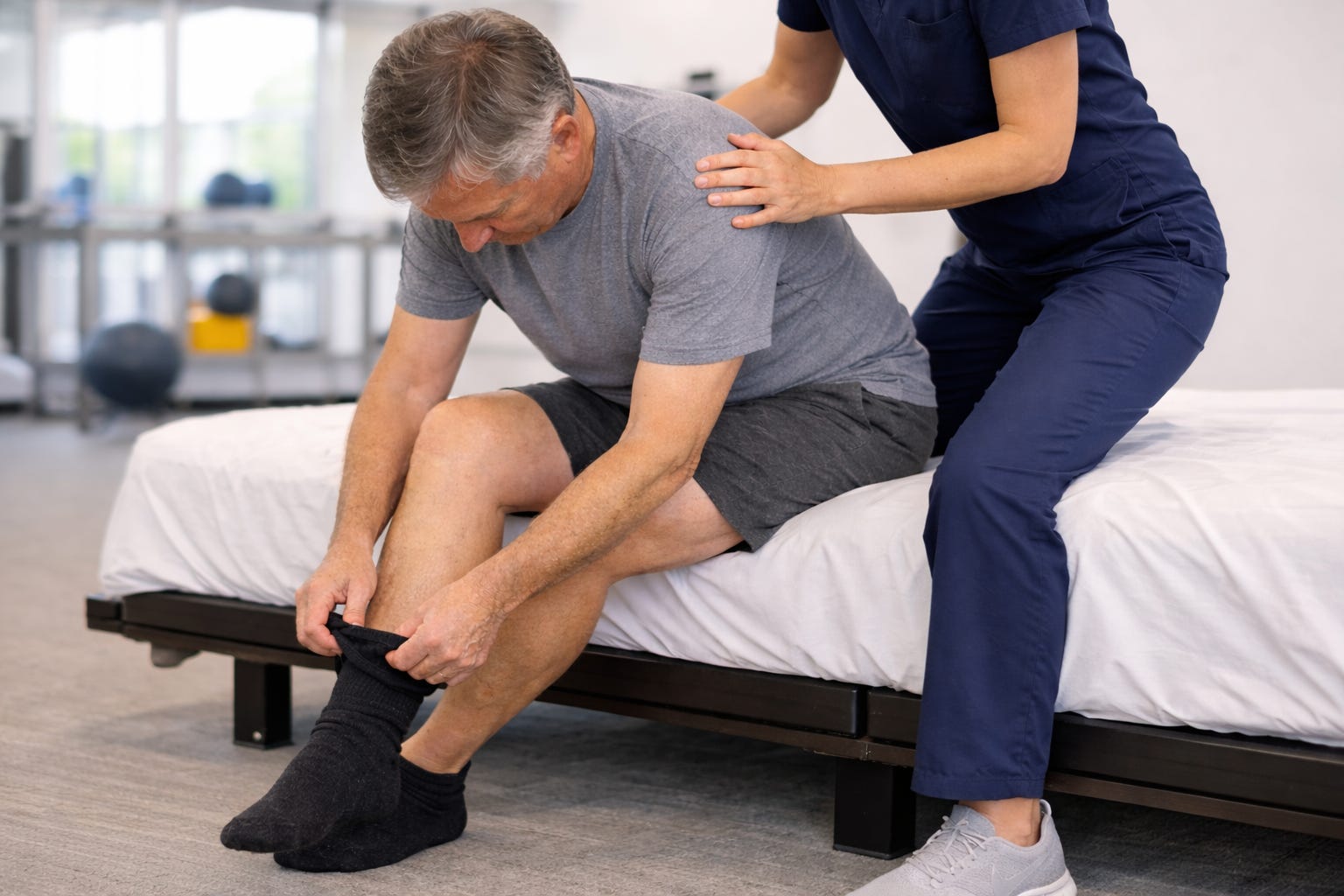
In adult rehabilitation, self-care tasks are rarely limited by a single variable. A patient may have adequate range of motion, fair strength, and intact task knowledge, yet bathing still feels unsafe. Dressing still looks effortful. Transfers still require more assistance than expected.
Self-care tasks may look different from one another, but they all place steady and sometimes complex demands on the trunk. Some require staying upright for longer periods. Others call for controlled forward movement, rotation, weight shifting, or gradual lowering with control. On the surface, the activities vary. Underneath, they all rely on coordinated trunk control so the arms and legs can move efficiently and safely.
In this post, we’re going to take a structured look at four high-impact self-care activities in adult practice:
Bathing
Upper body dressing
Lower body dressing
Toileting
For each, we’ll break down the postural requirements, identify the movement patterns that tend to break down, and outline interventions that directly support safer and more efficient performance. Throughout, we’ll stay focused on:
Movement patterns
Balance
Coordination
Posture
And most importantly, we’ll keep the reasoning clear. Impairment should connect directly to intervention. Intervention should connect directly to occupational performance. When those links are visible, treatment becomes more intentional, and progress becomes easier to measure and document. Each intervention includes a sample note so you can see how the clinical reasoning translates clearly onto the page.
Bathing
Bathing places steady and repeated demands on the trunk. It involves reaching, bending, rotating, and shifting weight over and over again, often in a wet or confined space that increases the need for stable postural control. The trunk has to stay engaged while the arms are constantly working and recover smoothly after each movement. When that control isn’t consistent, the task starts to look slower, more effortful, or less steady. In adult rehab, bathing often makes postural limitations more visible because its dynamic, multi-directional nature exposes control and endurance challenges that may not appear during simpler tasks.
Postural Demands of Bathing
