

Interventions That Improve Functional Movement Without Practicing the ADL
How to Target Movement Patterns That Drive ADL Performance
Understanding the Shift from Assessment to Performance
In occupational therapy, the way a task unfolds often reveals more than what is seen during assessment. Strength appears adequate and sitting balance is maintained during assessment, but once the activity begins, the quality of movement changes. Grooming slows down and becomes less stable. Dressing includes frequent pauses. Bathing appears more effortful than expected, even when the movements themselves seem simple. This is where treatment planning can either become highly skilled or unintentionally repetitive.
Practicing the ADL alone does not always change the outcome. When repetition is not supported by targeted movement work, the same patterns that limit performance often continue to show up. Improvement in functional performance often comes from addressing how the body organizes movement during the task. At this point, movement-focused intervention becomes essential.
When therapists begin to target trunk control, weight shifting, coordination, and movement transitions directly, ADL performance often changes without the ADL being practiced in isolation. The body becomes more efficient at organizing movement, allowing tasks to unfold with less effort and fewer interruptions. Movements that once required extra time or compensation begin to feel more controlled and consistent. As these patterns improve, patients are better able to carry those changes into everyday routines.
This article walks through how to design those interventions with intention, how to progress them, and how to connect them clearly to occupational performance.
Why ADL Practice Alone Is Not Always Enough
ADLs are complex and require the integration of multiple performance skills occurring at the same time. For example, postural stability supports reach, weight shifting allows one limb to move freely, and trunk rotation creates access to space, while controlled transitions allow the task to continue smoothly. When any of these components are disrupted, the task begins to change.
What often appears as difficulty with dressing or grooming is frequently a reflection of how the body is managing movement within the task. If intervention stays focused only on repeating the ADL, the underlying movement pattern may remain unchanged.
The therapist may observe:
Increased reliance on compensatory strategies
The patient may stabilize with both upper extremities when only one is needed, lean excessively instead of rotating, or use momentum to complete parts of the task. These strategies often allow the task to continue but reduce movement control and limit efficiency.Slowed task completion
Movements may appear hesitant or segmented, with frequent pauses between steps. The patient may take additional time to initiate movement, reposition, or regain balance before continuing the task.Decreased movement efficiency
The task may require more steps or more effort than expected. Movements may appear less direct, with repeated adjustments or unnecessary repositioning as the patient works to complete each part of the activity.Increased fatigue during the task
The patient may demonstrate reduced endurance as the activity progresses, requiring rest breaks or showing a decline in movement quality. As fatigue increases, compensatory strategies often become more pronounced.
When treatment shifts toward the movement patterns themselves, the therapist can influence how the task unfolds before returning to the full ADL. This is where intervention becomes more precise.
Core Movement Patterns That Drive ADL Performance
Before designing intervention, it helps to clearly define what you are targeting.
Across dressing, feeding, grooming, bathing, and toileting, several movement patterns consistently influence performance:
Trunk stability during upper extremity movement
Controlled weight shifting to allow limb advancement
Coordinated reach with trunk rotation
Dynamic balance during task progression
Controlled movement transitions between positions
Each of these can be addressed directly through intervention without requiring full ADL practice.
Intervention Approach 1: Trunk Control During Functional Reach
Why it matters
Many ADLs require the arms to move away from the body while the trunk provides a stable base. When trunk control is limited, the body often compensates with excessive leaning, loss of alignment, or reduced reach distance.
This can become visible during:
Reaching to thread clothing
Accessing grooming items
Managing bathing tasks at midline or beyond
Intervention examples
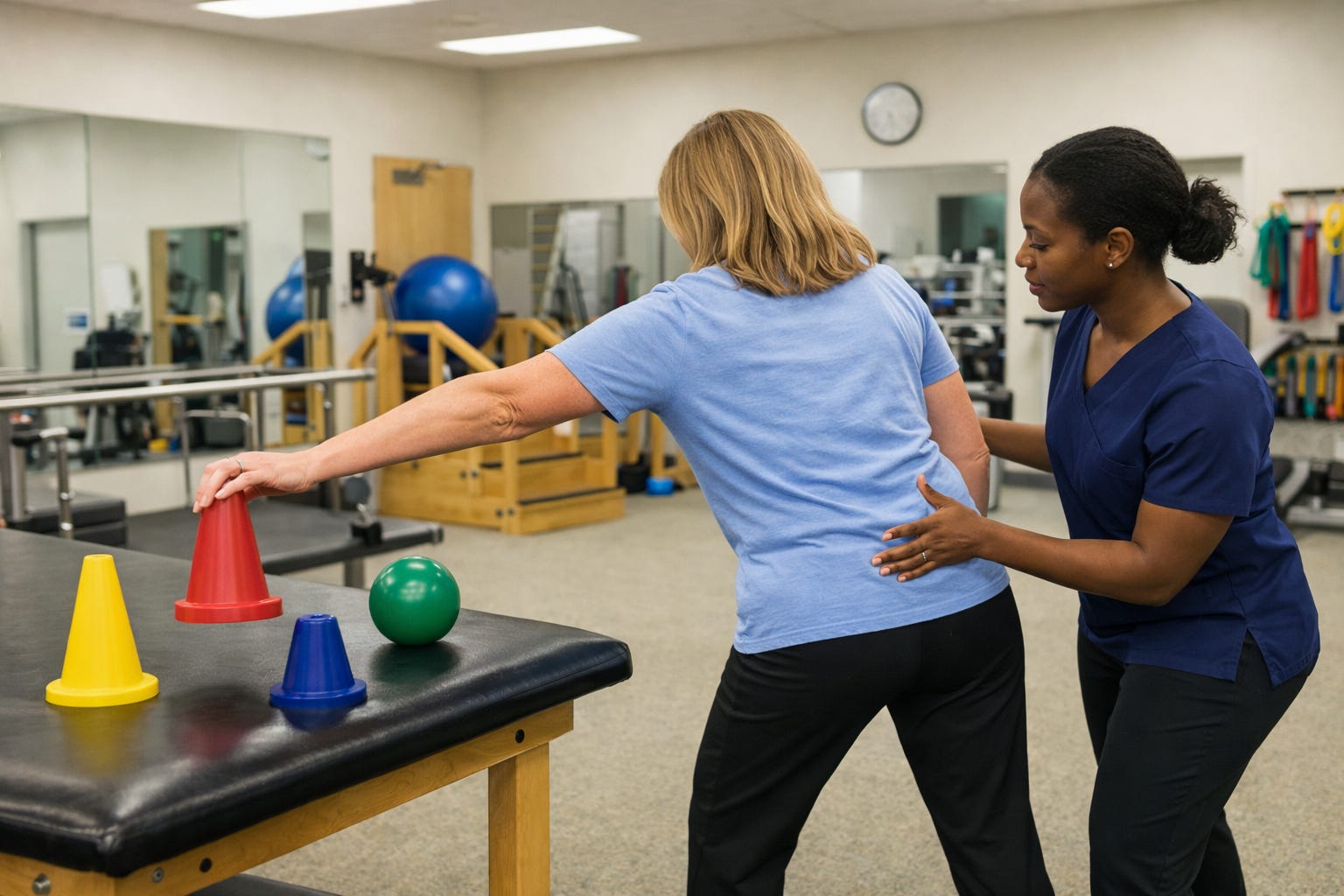
Seated reaching to varied targets placed:
At midline
Targets placed directly in front of the patient allow for initial focus on upright postural alignment and controlled upper extremity movement. This position supports early practice of reach without requiring significant weight shifting, allowing the therapist to cue trunk activation and reduce excessive leaning or collapse.Slightly outside base of support
Targets placed just beyond midline begin to introduce controlled weight shifting and trunk engagement. The patient is required to move outside of a stable position while maintaining alignment, supporting the development of dynamic sitting balance and more coordinated trunk movement during reach.At different heights
Varying the vertical position of targets challenges the patient to adjust trunk extension, flexion, and upper extremity movement patterns. Lower targets may require controlled forward movement, while higher targets encourage upright posture and controlled upward reach. This variability helps prepare the patient for the range of positions required during ADLs such as dressing and grooming.
Therapist provides graded support at the trunk to:
Facilitate upright alignment
The therapist applies light tactile input at the trunk to help the patient find and maintain a more neutral, upright position during movement. This may include cues at the pelvis, lower trunk, or upper trunk depending on where control is limited. The goal is to support alignment without fully correcting it, allowing the patient to actively engage postural muscles while reducing excessive leaning or loss of midline.Guide controlled rotation
Hands are positioned to assist with initiating and controlling trunk rotation as the patient reaches across midline or toward varied targets. The therapist helps pace the movement, encouraging smooth, continuous rotation rather than segmented or abrupt patterns. This support allows the patient to experience more efficient movement while gradually building their ability to control rotation independently.Reduce collapse or overcompensation
The therapist provides just enough support to prevent sudden loss of alignment or excessive use of compensatory strategies such as trunk collapse, shoulder hiking, or momentum-based reaching. By moderating these patterns in real time, the therapist helps the patient develop more controlled and efficient movement strategies that can carry over into functional tasks.
Objects can include cones, rings, or simulated ADL tools to maintain functional relevance.
Progression ideas
Increase reach distance
Gradually placing targets farther from the body increases the demand on trunk control and postural stability. The patient must move further outside of their base of support while maintaining alignment, requiring more controlled activation of the trunk and greater movement precision during reach.Vary direction of reach
Changing the direction of reach challenges different movement patterns, including lateral weight shifting, forward movement, and rotation across midline. This variability prevents the patient from relying on a single strategy and encourages more adaptable, coordinated movement that better reflects the demands of ADLs.Reduce external support from therapist
As control improves, the therapist gradually decreases tactile input or physical assistance at the trunk. This shifts more responsibility to the patient for maintaining alignment and controlling movement, supporting the transition from guided movement to independent performance.Introduce dual-step sequences (reach, return, reposition)
Adding sequencing increases the complexity of the task by requiring the patient to move, stabilize, and prepare for the next movement. This supports the development of movement continuity and coordination across multiple steps, which more closely reflects how ADLs are performed in real-world contexts.
Clinical reasoning connection
This intervention directly supports the ability to maintain postural alignment while the upper extremities move through space. Improved trunk control allows the arms to function more efficiently during ADLs, reducing effort and improving task flow.
Documentation example
Objective: Patient engaged in seated reaching activity to targets placed outside base of support. Therapist provided intermittent tactile cues at trunk to facilitate upright alignment and controlled rotation. Patient demonstrated ability to maintain midline positioning during upper extremity movement with decreased episodes of trunk collapse.
Assessment: Patient demonstrates improved trunk control and postural alignment during dynamic reaching tasks, supporting increased stability during upper extremity movement. Improvements indicate enhanced ability to perform functional reach required for grooming and dressing activities.
Intervention Approach 2: Weight Shifting to Support Limb Advancement
