

How to Document OT Interventions So Your Clinical Reasoning Is Clear
Language that helps your clinical thinking come through clearly in every note.
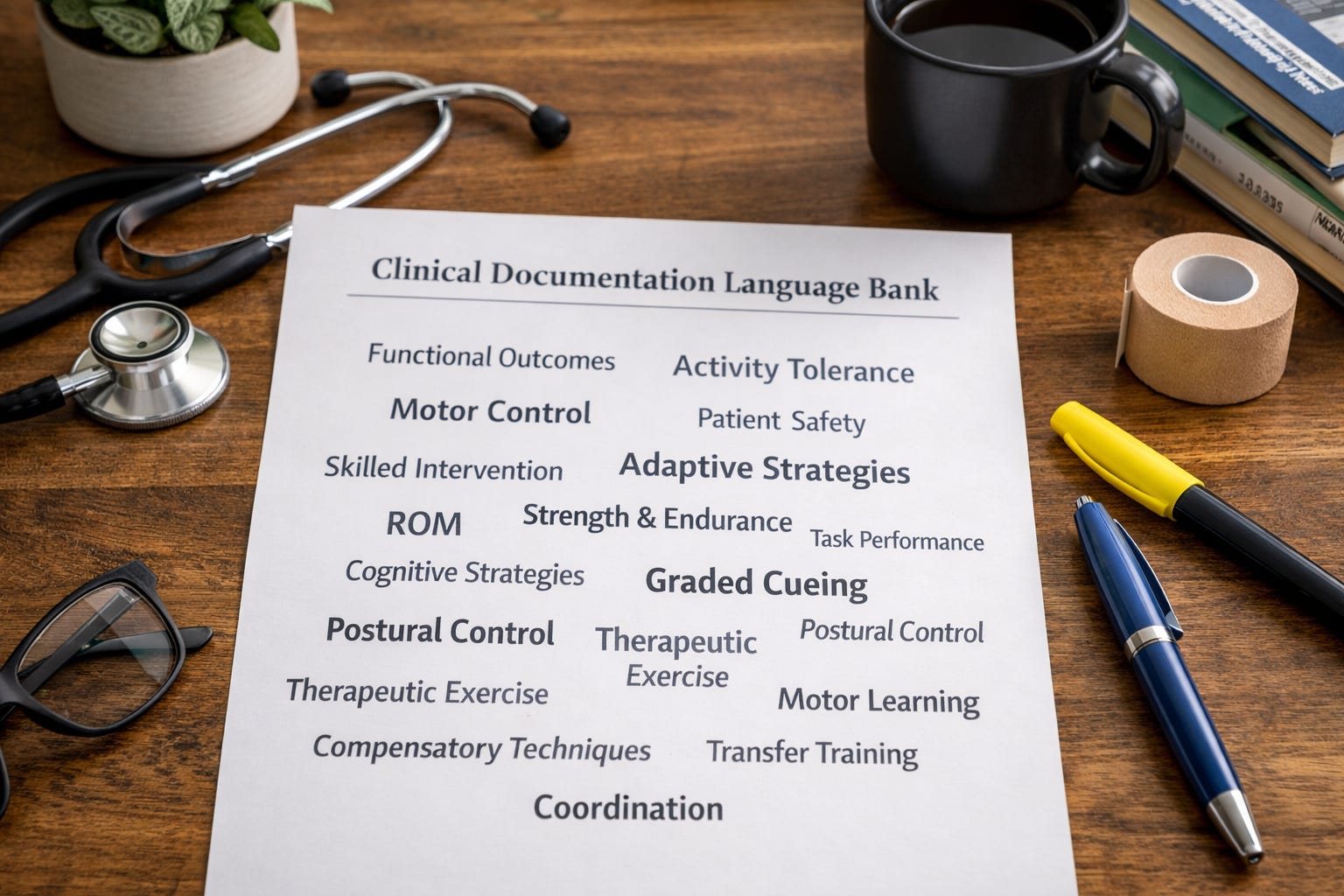
Choosing the right intervention is only part of skilled practice.
The other part is being able to clearly explain why that intervention was necessary, in language that reflects clinical reasoning, medical necessity, and functional relevance.
This post addresses a common question:
How do I put my intervention decisions into words that sound skilled, logical, and defensible?
Your documentation is the primary way your clinical reasoning is understood.
And this is where many good sessions fall apart. Not because the treatment was wrong, but because the why never made it onto the page.
This language bank gives you:
Phrases that show clinical reasoning (not just actions)
Structure for linking intervention choice to functional need
Examples for ADLs, Therapeutic Exercise, Therapeutic Activity, and Neuromuscular Re-education
Language that can be adapted without turning your notes into generic notes
Core Documentation Formula (Foundation for All Sections)
Use this structure to anchor your sentences:
Patient engaged in [intervention type] to address [specific barrier] impacting [functional task]. Task was graded by [how] to improve [functional outcome].
This formula ensures you always document:
What you did
Why you chose it
How it was modified
What function it supports
Everything below fits into this framework.
ADL (Task-Based Training): Language Bank
Use when:
The patient needs to practice the actual task
The barrier is embedded in task performance (sequencing, safety, initiation, coordination, balance during the task)
Intervention Selection Phrases
“ADL training was selected to directly address impaired task execution affecting…”
“Task-based intervention was chosen due to the patient’s difficulty performing… despite adequate underlying strength.”
“Direct practice of [task] was indicated to improve carryover and safety within real-world performance.”
